

SCALING SMARTER
•
SCALING SMARTER •
Enablement blueprint for scaling businesses
You don’t have an enablement problem. You have a commitment problem.
And that’s why it keeps getting reset, rebranded, or deprioritzed.
Over the past year, I’ve written a lot about enablement.
What it is, what it isn’t, why onboarding doesn’t stick, why SKOs rarely change behavior, why teams keep rebuilding the same assets over and over again… And the more I reflect on all of this, the clearer one thing becomes:
Most companies don’t struggle with enablement because they lack frameworks, content or talent. They struggle because they never fully commit to it.
Enablement isn’t broken: it’s treated as temporary
This pattern shows up again an again.
A new strategy is announced, enablement gets involved to “support the rollout”. There’s training, decks, workshops, sometimes even an academy. For a moment, everything feels aligned.
Then priorities shift. A new quarter starts. A new leader joins… And suddenly, enablement is back on the table - being reworked, rebranded, or quietly deprioritized.
Nothing was fundamentally wrong with what existed. It just wasn’t given the time to do its job.
That’s not a design issue: it’s a commitment issue.
We keep expecting enablement to work like a project
One this that keeps coming up, no matter the angle, is this expectation that enablement should work like a project.
We launch something, we train everyone, we move on.
We’ve seen how that plays out. One-off sessions don’t scale. Onboarding creates momentum, but not consistency. SKOs generate energy, but rarely change behavior beyond the first few weeks. Even well-designed programs lose impact when nothing reinforces them.
Each time, the conclusion is the same: the problem isn’t the idea itself. It’s what happens after.
Enablement keeps being treated as a moment in time, when in reality it’s a continuous motion. And when that motion stops, everything starts slipping back to the default.
Enablement only works when it becomes a system
The teams that actually get value from enablement don’t do more. They do it differently.
They start by creating clarity instead of assuming they already know where the gaps are. They pay attention to execution, not just intent. They involve managers early, knowing that reinforcement doesn’t happen in enablement sessions - it happens in 1:1s, pipeline reviews, and everyday conversations.
Most importantly, they don’t treat enablement as something to “roll out” once and move on from. They treat it as a system that needs to be run, adjusted, and reinforced over time.
The questions shifts from “have we launched this?” to “is this still being used the way we intended"?”
That’s when enablement stops feeling fragile and starts compounding.
Commitment doesn’t mean full agreement, and that’s why it works
One thing I learned early in my career is that commitment doesn’t require everyone to be 100% convinced.
You can disagree. You can have doubts. You can even think there might have been a better option. But once a strategy is agreed on, commitment means moving forward and executing on it, together.
That distinction matters a lot in enablement.
Too often, enablement fails not because the strategy was wrong, but because leadership never fully committed to make it work. They approved the initiative, but didn’t actively support it. They aligned on the direction, but didn’t reinforce it. They launched it, but didn’t drive adoption.
When it comes to enablement, commitment looks like leaders backing the strategy through execution - even when it’s uncomfortable, even when results take time, even when not everyone was initially convinced.
That’s the difference between enablement as a nice idea, and enablement as a real execution lever.
What to take into 2026
As you head into the next year, I’d encourage you to stop asking whether enablement is “working”.
Instead, ask:
have we given it enough time?
are managers reinforcing it consistently?
are we measuring adoption rather than attendance?
and are we willing to stick with it when it feels uncomfortable?
Because if enablement gets rebuilt every time things get hard, it will never deliver the results everyone expects.
And if there’s one thing this year of Scaling Smarter should leave behind, it’s this: the teams that win aren’t the ones with the most enablement. They are the ones that stay the course.
— Ambre
The real measure of enablement is what people remember three months later
Why enablement fails after onboarding, and what to do instead.
You finally launched the onboarding. The sessions went smoothly, everyone was engaged, and the feedback looked great.
But a few months later, something feels off. People have gone back to their old ways. The new habits aren’t sticking.
We’ve all seen it happen, and it’s frustrating. You spent weeks planning, training, documenting… only to realize it didn’t really change how people work.
That’s not a training issue… It’s a reinforcement issue.
Training builds awareness, reinforcement builds consistency
Most enablement programs stop right where the real work begins.
You can teach a process in a few hours, but it takes repetition and accountability for it to become second nature.
And without reinforcement, people naturally default to what’s familiar - especially under pressure.
Reinforcement is what helps new behaviors survive past the kickoff energy. It’s what turns a great learning experience into real, measurable change.
What reinforcement actually looks like
Reinforcement isn’t about re-running the same training every few months. It’s about weaving new skills and messages into the day-to-day.
Here’s what that can look like in practice:
Manager-led coaching
Managers are the real multipliers. when they use team meetings and 1:1s to revisit key themes, adoption goes up - because people learn in context, not in isolation. More about it in Manager enablement: the revenue lever you forgot about.
Real-world practice
Roleplays, deal reviews, peer sessions… anything that helps people apply what they learned, not just remember it. Small repetitions matter more than one big event.
Micro refreshers
A five-minute Loom, a quick checklist, a short update - short enough to be useful mid-week. If it takes longer than a coffee break, it’s too heavy to be considered “micro learning”.
Peer sharing
People copy what they see working. Let top performers share what’s landing: it builds trust and speeds up adoption faster than another formal session.
When onboarding ends, enablement should just be getting started
Training builds awareness, it gives people the “what” and the “why”. Reinforcement is where it turns into action. It’s the bridge between knowing and doing - and the reason some enablement programs become part of the company’s DNA while others fade after a few weeks.
Because learning isn’t a one-time event - it’s a continuous part of how teams operate.
How Scaling Edge makes it stick
At Scaling Edge, every engagement is built with reinforcement in mind from day one. That means:
Programs designed around manager-led coaching and peer learning
Reinforcement assets built for quick reference and real use
Follow-up cadences that make new behaviors visible in performance metrics
Because enablement only works when it sticks - not just when the launch went well.
If you’re planning on hiring in 2026 or if your SKO feels like déjà vu every quarter, this edition is for you. Let’s make the next one actually last.
— Ambre
Do less, win more: how to cut your GTM clutter before 2026
Clarity isn’t a luxury. It’s the new growth lever.
Everyone is talking about what to roll out next year.
New onboarding, pitch decks, partner programs, tools…
But if your teams are already overwhelmed - adding more won’t help. In fact, it will likely make things worse.
Before you roll out anything new, start by cutting what’s not working.
Most GTM orgs are scaling clutter, not clarity
Every year it compounds:
Legacy onboarding docs that no one uses
Notion pages that haven’t been touched since Q1
Frameworks that change faster than reps can adopt them
Content libraries full of duplicates, versions, and outdated messaging
Training sessions that get great feedback… but changes nothing
It’s not bad intent. It’s just that no one ever stops to clean it up - because there’s always something new to launch.
The results? Your best reps ignore it all and build their own system.
Everyone else gets stuck in the noise.
Enablement should be scaffolding, not noise
Good enablement removes friction.
But when it’s overdone or disconnected from reality, it becomes its own scalable:
Content that’s hard to find
Playbooks that don’t reflect how deals are actually closed
Initiatives that no one reinforces
Messaging changes that never make it into the field
When everything is enabled, nothing is.
If it doesn’t help someone sell, support, or close - it’s in the way.
3 things to clean up before you scale into 2026
You don’t need to start from scratch: just need to clean house before inviting more people in.
🧹 Old playbooks
If they haven’t been updated in the past 6+months, check what’s still relevant, what’s being ignored, and how your top reps are actually selling today
🧹 Content sprawl
Pick one source of truth. Archive the rest. If your team doesn’t know where to find the right messaging or deck, they’ll stop trying.
🧹 Competing priorities
Look at every GTM initiatives launched in the past 6-9 months. If you’re reinforcing more than 3, chances are none of them are landing.
Do less, but make it count
This isn’t about being minimalist. It’s about being effective.
Your GTM teams don’t need another folder of docs. They need fewer moving parts, better adoption, and clear execution.
That’s what I do at Scaling Edge:
Cut through the noise
Use The Enablement Handbook to audit what’s working at each stage of your GTM motion
Build lean enablement systems that teams actually use.
Want to start 2026 with a system your teams believe in - not just another Notion page? Let’s make space for it, now.
—
Ambre
You don’t need another kickoff. You need a plan.
Why most SKOs flow, and what to do instead.
The decks are being built. The vision slides are getting polished. And most companies are about to spend a lot of time (and budget) on a kickoff that won’t actually change how their teams operate.
Why?
Because the planning window is closing. And the real work hasn’t started yet.
Most kickoffs don’t lack content - they lack clarity
You’ve seen this movie before:
Leadership presents the annual startegy
Marketing introduces new messaging
Enablement runs a couple of sessions
Everyone nods along
A few people post on LinkedIn
And then… business as usual.
It’s not a content problem: it’s a follow-through problem.
The team leaves inspired, but without a clear answer to: “What exactly are we doing differently on Monday?”.
That’s where most kickoffs fall flat.
Kickoff is a GTM reset moment - but only if you plan for it.
A well-run SKO or CKO can reset how your entire GTM org operates.
It’s your moment to:
✔️ Launch new motions
✔️ Introduce refined processes
✔️ Align go-to-market plays across Sales, CS, and Partners
✔️ Reignite momentum with real focus
But that doesn’t happen in January. By then, reps are back in the field. Leaders are back in meetings. the window closes fast, unless you plan now.
3 things your kickoff needs to actually move the needle
Here’s what separates a “good event” from an execution catalyst:
#1 A shortlist of shared priorities
What are the 2-3 things the entire GTM org is focused on?
Don’t list 10 goals. Don’t build 8 decks. Choose what matters and make it stick.
#2 Real-world process and expectation setting
Not just a vision. What’s changing in how we sell, onboard, qualify, support?
The more real it gets, the more likely it sticks.
#3 A plan for what happens after
Reinforcement isn’t a follow-up email… It’s the managers who coach it, the templates that drive it, the check-ins that make sure it lands.
No time to plan properly? That’s where I come in.
I don’t run SKOs for the hype.
At Scaling Edge, I help GTM leaders turn kickoffs into execution accelerators - with clear priorities, real content, and post-event reinforcement.
If your team is focused on closing Q4 (and they should be), but you still want January to count - I’ll help yo get it done.
Planning your 2026 kickoff? Now’s the time.
Let’s turn it into something that actually changes how your team executes?
— Ambre
Want to close Q4 strong? Start here.
4 enablement fixes that actually move revenue now.
It’s that time of year.
Targets are looming, deals are dragging… And GTM teams are trying to do everything - right when they should be doing less, but better.
Right now isn’t the moment to launch big programs or overhaul systems. It’s about focus, consistency, and making sure what' you’ve already built is actually being used.
Here are 4 quick enablement fixes that can still unlock revenue before the end of the year. No fluff, just traction.
#1 Pipeline hygiene = focus mode
Forecast don’t close deals - reps do. And nothing wastes time faster than chasing deals that were never real to begin with.
This week is the time to sit down and get ruthless:
What’s actually qualified?
What’s just noise?
Where are we spending energy that won’t come back?
If it’s not winnable, clear it out. No more happy ears.
Reps need clarity, not chaos. And your forecast needs reality, not hope.
#2 Manager coaching = ONE thing
If you’re a manager, this is not the time to roll out new frameworks. This is the time to go back to basics: your basics.
Think:
What’s one best practice you’ve seen close deals in your org?
A talk track that lands?
A sequence that gets replies?
A tactic that won a tough renewal?
Pick it, name it, reinforce it daily.
When everything is urgent, focus wins.
#3 Reactive dormant partners
Pipeline feeling thin? You might already have warm deals hiding in partner relationships.
Think about:
That partner who committed but never launched
The one who intro’d a deal that fizzled out
That joint use case you agreed to co-sell on, but never followed through
Now it’s time to re-open those convos. They’re under pressure to close the year strong too… You might be able to move faster together than alone.
#4 Remove internal blockers
The pressure is high, and effort isn’t the issue. Misalignment and internal friction are what slow deals down.
Enablement should be in the field right now - not just building, but unblocking.
Do reps know what’s launching in the product roadmap this quarter?
Are they all using the same pitch deck… or version 7 of 3 different versions?
Are CS and Sales aligned on implementation timelines and handover expectations?
If not, fix it now. One clear answer can save a deal
Q4 is not the time for perfect. It’s the time for execution.
Don’t launch a new strategy. Don’t wait for a perfect deck. Don’t try to coach five things at once.
Choose what works. Reinforce it. Remove distractions.
That’s how you close strong.
At Scaling Edge, I help GTM teams do exactly that: get clear, get focused, and get things across the finish line.
Need one last push before the end of the year? Let’s talk.
— Ambre
The hidden cost of misaligned GTM priorities
And how enablement turns alignment into revenue
Alignment looks great in a slide deck.
But when your GTM teams are pulling in different directions, the cost shows up in real business performance. And no one feels it more than the C-suite.
Misalignment hits where it hurts: the numbers
When priorities aren’t aligned across Sales, CS, Marketing, and RevOps, you don’t just slow down execution.
You lose traction where it matters:
Win rates drop when messaging is inconsistent
Ramp time increases when onboarding serves too many masters
Forecast accuracy tanks when Sales and RevOps aren’t aligned
Customer experience breaks when CS doesn’t have the right handover context
Rework multiplies across every initiative
It’s rarely visible on the P&L - but it’s absolutely hitting your revenue.
Real example: the forecast that broke board trust
I spoke with this one company, the sales org was forecasting $2.8M in revenue for Q2. But only $1.9M closed.
Why? The forecast methodology was solid, but it was ignored.
Sales leaders didn’t reinforce the process, reps filled in CRM based on gut feel. RevOps was frustrated, Enablement was sidelined, and Finance had to explain a $900K gap to the board.
The cost?
Lost credibility
Emergency pipeline pushes
Executive fire drills
Internal finger-pointing
And it all started with one thing: misalignment.
Enablement is your multiplier - if aligned
Here’s the good news: when GTM teams are aligned on what matters, enablement becomes your revenue execution system.
In the forecast example, here’s what I recommended to that company:
Step 1: Make the process visible
Ensure the forecasting methodology is clearly documented, easy to access, and communicated across the entire revenue org.
That includes defining the stages, expectations, and what good data hygiene looks like.
Step 2: Equip managers to reinforce it
This is where the adoption happens. Provide managers toolkit with pipeline review prompts, deal stage coaching questions, and follow-up reminder.
Support them with light data hygiene coaching and regular check-ins so they can hold the process over time.
Forecasting isn’t overly technical - it’s about consistency and shared understanding. Enablement doesn’t necessarily own the process, but it does own the execution layer that ensures it’s actually followed.
Because how many times have you seen a great process… that nobody actually sticks to?
Start with visibility, then fix what matters
Misalignment isn’t always obvious.
That’s why every Scaling Edge engagement starts the same way: with a GTM Enablement Audit.
We look at:
Where teams are misaligned
Where execution is breaking down
Where enablement can have the highest impact
Only once you see the gaps, you can finally fix them.
Missed the last edition on how to run an audit? It’s worth the read.
And if this edition hit a little too close to home? Let’s talk.
— Ambre
Want to fix your GTM? Start with an enablement audit
Because building more won’t help if you don’t know what’s broken.
It’s planning season.
GTM leaders are reviewing the year, updating Q4 goals, and asking the usual question:
“What do we need to fix?”
The instinct is to build something: new onboarding, new messaging, new tools… But if you don’t understand where the real friction is - you’re just guessing.
Most teams build without diagnosing first
In nearly every engagement I’ve worked on, the symptoms are the same:
training launched, but adoption is low
content exists, but reps don’t use it
tools bought, but not integrated into the workflow
coaching exists, but doesn’t reflect the GTM strategy
Why does this happen? Because execution is misaligned, and nobody’s mapped it clearly.
The “we need a certification program” trap (or any other enablement assets we can think of)
Here’s a real example.
A sales leader once told me: “We need a pitch certification… something formal, with scoring and badges”
We spent weeks building it. Decks, rubrics, recordings, practice sessions - the whole thing. It launched. Reps completed it. Everyone felt accomplished. But here’s the problem: it didn’t impact revenue, at all…
Because the real issue wasn’t the pitch. It was qualification. The pipeline was full of misaligned deals: wrong personas, wrong needs, wrong timing… So reps were wasting time pitching to people who were never going to buy. We addressed a visible problem… but missed the real one.
Why? Because we rushed into the request without doing an audit first.
What an enablement audit actually is (and isn’t)
An Enablement Audit isn’t a report or a status update. It’s you’re execution x-ray. It gives you a clear, structured view of:
where teams are wasting time
where handoffs are broken
where duplicated effort is hiding
where your onboarding, coaching, and process don’t match the actual GTM motion
You don’t need to guess. You need visibility.
5 things a good audit includes
✓ Map the GTM journey -> how do buyers and partners actually move?
✓ Assess key touchpoints -> what’s defined? what’s working? what’s missing?
✓ Interview stakeholders -> Sales, CS, Marketing, Ops, Managers…
✓ Spot patterns -> misalignment, duplication, content gaps
✓ Prioritize action -> what will unblock execution right now?
This is where enablement starts to become strategic - not reactive.
Why Scaling Edge starts with an audit
I don’t build onboarding, training, or enablement programs without one. Because otherwise, I’m just guessing - and so are you.
Whether we’re solving adoption, designing onboarding, or preparing for a GTM shift, the first step is the same: get clear on what’s actually broken, then fix it.
The Enablement Handbook includes my full audit framework.
Want help running one inside your team? Let’s talk.
— Ambre
The onboarding trap: fast ≠ effective
Why back-to-school season is the perfect reminder that great onboarding takes more than speed.
It’s September. New faces, new routines, a fresh notebook or two.
The energy? It’s giving la rentrée (aka back-to-school season in French). Only this time, it’s not school - it’s onboarding season.
For GTM teams, that means welcoming new reps, CS managers, or partner folks and getting them “ramped” fast. But here’s the trap: ramp time is not the same as readiness.
The pressure to onboard fast
Revenue leaders love a short ramp. Time-to-first-deal, time-to-pipeline, time-to-productivity… All going down means it’s good, right?
Not always. Here’s what often happens instead:
new hires get a one-week info dump
they’re flooded with decks, tools, and acronyms
then sent into the field under pressure to perform
a month later, they’re confused, inconsistent, and quietly rebuilding their own version of “how to do the job”
Onboarding ends, but performance is just beginning.
Common onboarding traps
Here’s what I see again and again in scaling GTM orgs:
Front-loaded info -> everything in week one, nothing retained
Product-heavy focus -> not enough on how we actually sell, support, or partner
No connection to the real world -> theory without peer shadowing or manager feedback
No reinforcement plan -> no follow-up, no coaching cadence, no documentation
No defined ramp goals -> reps complete onboarding but have no idea what success looks like
If this sounds familiar, you’re not alone. But here’s the good news: onboarding doesn’t have to be perfect - just purposeful.
What great onboarding actually looks like
Great onboarding isn’t fast. It’s frictionless. It builds confidence, consistency, and actual behavior change. And it’s built on three core levers:
#1 Manager & peer enablement
New hires should learn how we actually work, not just what the playbook says. That means:
shadowing high-performing peers
sitting in on real calls and meetings
getting coaching from their manager from week one
#2 Structure & documentation
Clear onboarding tracks, milestone-based progress, and a central place to find everything they need. Docs and templates alone won’t drive performance, but they’re essential scaffolding.
#3 Practice & iteration
Real-world exercises. Call roleplays. Prospecting practice.
It’s not about what they’ve “read” - it’s about what they can actually do.
If you just want a fast onboarding, focus on docs & practice. But if you want an onboarding that’s effective, focus on managers, peers, structure, and repetition.
Because onboarding isn’t a one-week sprint. It’s the first 30-60-90 days of shaping how people think, speak, and operate inside your GTM motion.
Your onboarding is your enablement engine
If your onboarding is messy, your enablement programs will always feel reactive. If it’s strong, everything else scales faster.
I’ve seen teams invest in decks, training, certifications - only to watch it all fall flat because onboarding didn’t give people the right foundation to begin with.
At Scaling Edge, onboarding is always part of the conversation.
Whether you need to design it from scratch or optimize what’s already there, I help GTM teams build onboarding programs that actually stick - and scale.
📘 The Enablement Handbook includes my onboarding checklist and planning framework.
💭 Need to rethink onboarding for H2? Let’s talk about how to build one that drives real performance.
— Ambre
Most GTM teams are adding AI. Almost none have the enablement for it.
Why an enablement audit is the smartest place to start.
AI is officially everywhere.
GTM leaders are rolling out copilots, piloting AI tools, and looking for any way to drive efficiency. Some are even considering replacing parts of their team with AI agents (without fully understanding the human workflows, adoption barriers, or enablement systems behind them).
The pressure is on - from boards, execs, and the market - to “do something with AI”.
But let’s be honest: most teams don’t have an AI strategy… they have AI experiments.
More tools ≠ better execution
The truth is, you don’t need another AI tool right now. You need clarity.
Because here’s the thing: AI doesn’t fix bad execution. It scales it.
If your teams don’t know the process, the messaging, the way to qualify, coach, or close - AI will just help them do the wrong thing faster.
That’s why I don’t start with tools. I start with a GTM Enablement Audit.
How enablement audit makes your AI strategy smarter
An enablement audit gives you a clear picture of what’s working - and where your GTM motion is breaking down.
Here’s 4 things it helps you uncover:
Where teams are guessing instead of following clear process
Where effort is duplicated manually across Sales, CS, Partnerships, and Marketing
Where valuable insights are being lost (in call notes, Slack, spreadsheets…)
Where reps are stuck searching instead of selling
That’s the kind of insight you need before implementing AI.
Otherwise, you’re automating chaos.
Where AI can make a difference
Let’s be clear: there are dozens of potential AI use cases in GTM, and more popping up every day.
But smart enablement leaders don’t try to automate everything at once. They start where AI can bring immediate value to the team - so adoption is natural, not forced.
When people see the value early, they’re more excited about what’s next. When they don’t? You get resistance, frustration, and “that tool we tested and never used again”.
Here are a few high-impact, low-friction places to start:
Call summaries for coaching -> Let managers skip the admin and focus on quality feedback
MAPs or QBRs auto-filled from CRM or deal notes
Live battlecards or talk track reminders triggered during sales calls
Onboarding progress tracking -> real-time visibility into new rep ramp
Content suggestions or follow-up prompts based on deal stage
This isn’t about shiny tools. It’s about using AI where it helps your teams right now - and build momentum from there.
AI doesn’t replace enablement. It relies on it.
If you’re just layering AI on top of GTM chaos, you’re not innovation - you’re guessing.
But if you take the time to audit your current execution, you’ll see exactly where AI can amplify what’s working - and where it’ll just create noise.
At Scaling Edge, that’s where I always start: audit first; then build; then scale.
The Enablement Handbook includes my full audit framework - free to download.
Curious where AI could actually move the needle in your GTM? Let’s chat.
Manager enablement: the revenue lever you forgot about
Why your sales managers need enablement as much as your reps do.
Most companies train their reps and hope managers will “just coach”.
Spoiler: they don’t - and your shiny new programs die in 3 weeks.
Even the best-designed enablement program will fail if your frontline revenue managers aren’t reinforcing the change. And when I say managers, I’m thinking Sales Managers, Customer Success Managers, Partner Managers - the people who own revenue outcomes.
The hidden adoption killer
Managers are the bridge between strategy and execution. They control what gets talked about in team meetings, what gets coached, and what gets rewarded. Without them, all your beautiful assets and training fade into “remember that one workshop we did"?” territory.
High-quality sales coaching can elevate quota attainment by up to 19% - but most companies still skip enabling their revenue managers entirely. (Source)
3 ways to involve revenue managers from day one
#1 Give them the toolkit first
Managers should see the assets, success metrics, and coaching guides before the reps do. If they don’t understand it, they can’t reinforce it.
#2 Get their buy-in before launch
Invite managers to help shape the rollout plan. People support what they help create.
#3 Clear their calendar
The best coaching toolkit is useless if they have zero time to use it. Identify their bandwidth before launch - and adjust the plan so reinforcement fits into their actual week.
What happens when you skip it vs. when you get it right
A few years ago, I rolled out a new product for the teams to sell, upsell, and cross-sell. We had everything: pitch deck, one-pagers, talk tracks, onboarding, checklists - all high quality, easy to follow.
What we didn’t have? Managers’ time. Their role wasn’t fully defined in the process, and we didn’t account for their bandwidth.
The result: great materials, but poor adoption.
Fast forward to another rollout. This time, we had less bandwidth for perfect assets. Instead, I focused on the managers:
Sitting in on their coaching sessions
Checking how much time they had each week to reinforce change
Ensuring they could explain and champion the new process themselves
The result? Better adoption and stronger performance - because instead of one enablement person driving change, we had dozens of managers multiplying the message across their teams.
Manager enablement is not optional
If you want adoption to stick, you have to enable the enablers.
Every Scaling Edge program builds manager enablement into the rollout - because nothing scales faster than the people who already lead your revenue teams.
I’ve seen teams waste months on enablement programs that never stick. The Enablement Handbook will get you started - and Scaling Edge will make it work to the real world.
Curious what this could look like for your team? Let’s set up a quick intro call.
The difference between enablement that’s busy and enablement that works
If everything feels urgent, here’s how to cut through the noise.
Most enablement teams I meet aren’t lazy. They’re overwhelmed.
New deck request from Sales? ✅
Onboarding refresh for CS? ✅
Another training for Product Marketing? Sure, why not.
Before you know it, your Asana board looks impressive… But adoption is low. Nothing’s finished. And you’re too busy to prove impact.
Let’s fix that.
Busy ≠ strategic
Activity does not equal effectiveness.
Just because you’re building doesn’t mean you’re moving the business forward.
In fact, the fastest way to burn out your enablement team is to say yes to everything. When everything is a priority, nothing really gets prioritized.
Stop playing enablement whack-a-mole
We’ve all been there:
Sales asks for a new playbook
CS wants to revamp QBRs
Leadership suddenly wants to train everyone on a new ICP
Individually? Valid requests.
Collectively? A recipe for chaos.
Reactive enablement is a trap. You spend your time responding, not leading. Before you even start sorting through requests, pause and ask:
Does this support the company’s strategy?
Enablement only works when it drives execution of what matters most. (If you missed last edition on this, catch up here.)
Once you’re clear on that, then use the matrix to sort what’s worth doing now.
Use this matrix to cut through the noise
Here’s how I help teams prioritize what actually matters: (this isn’t rocket science, but it is powerful when used intentionally)
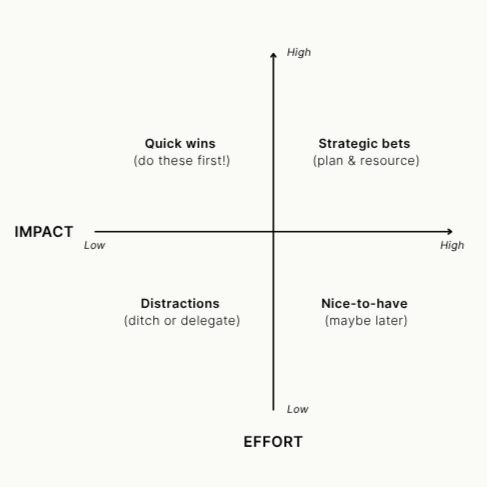
Use this matrix to prioritize enablement initiatives based on business impact and effort.
How to use this in real life
I once had a VP Sales, CS Director, and RevOps head all throw urgent enablement needs at me in one week.
Instead of scrambling, I invited them to a 45-min live workshop. We mapped everything into the matrix - together.
What happened?
We killed 4 initiatives (nobody missed them)
We rallied around 2 quick wins
We planned 1 strategic bet for next quarter
Bonus: They were bought in before I built anything.
Prioritization isn’t a just skill. It’s a survival strategy.
Enablement doesn’t fail because of bad ideas.
It fails because we try to do too much, too soon, for too many.
This matrix helps you zoom out, decide what actually drives revenue, and say “not now” with confidence.
Want the full planning toolkit?
I walk through this framework (and more) in The Enablement Handbook - a free guide for turning strategy into scalable execution.
Download it ➡️ here.
And yes - all past editions of Scaling Smarter are now on the website. You can also register there to get next ones by emails.
Let’s build smarter, not just busier.
Want help applying this? That's what I do at Scaling Edge.
— Ambre
Execution is the new growth engine: why enablement must drive revenue
Revenue per employee is the new north start - and misaligned execution is killing it.
The growth game has changed
We used to celebrate headcount growth like a badge of honor. But the era of "add more people to hit plan" is over. With AI reshaping the playing field, capital efficiency is now matters more than headcount.
PwC's June 2025 barometer shows the most AI-exposed industries are seeing three times higher growth in revenue per employee compared to less-exposed sectors. Tools like AI ensure fewer hands can do more - yet most GTM strategies still fail in the field, not on paper.
Execution has become the real growth engine. Enablement needs to take the wheel.
Enablement can no longer be reactive
Historically, enablement meant onboarding decks, reactive training, and ongoing firefighting. But the real blockers aren't lack of content - they are adoption and alignment,
When teams don't adopt, execution falls apart. Enablement doesn't need to own strategy or content, but it does need a seat at the table - so it can surface gaps and champion true adoption from day one.
Execution fuels scalable success
Structure, clarity, adoption - that's the new enablement playbook.
Consistent adoption is the new ROI lever. Studies show organizations with strong enablement deliver 8% more quarterly revenue and 84% more reps hit quota. That's the difference between a launch day and long-term traction.
Enablement's new role:
Be at the decision table from day one
Shape how strategy translates into daily actions
Ensure every new initiative is adopted in real time
As I discussed in the latest podcast episode What's Broken in GTM and How To Fix It, the missing link isn't more strategy - it's how to make it happen.
So what? What now?
CROs: rethink rollout strategy - execution accountability matters more than ever
Enablement professionals: claim your seat - enable strategy adoption from inception.
Execution is the new growth engine. Enablement is uniquely positioned to drive it.
The anatomy of an enablement academy
If your academy is just a Notion page with a few links, we need to talk.
Everyone wants an “academy” now. Sales Academy. CS Academy. Partner Academy. But more often than not, it’s just a fancy name for a folder of slides and some scattered Looms.
And hey - we’ve all started there.
But if you want your GTM teams (or partners) to actually learn, apply, and perform consistently, you need more than content - you need a program.
Why the shift? According to Insight Revenue’s State of Revenue 2025, one of the top challenges facing GTM teams today is execution. Not strategy. Not ideas... Execution!
That’s where structured enablement programs - aka academies - come in.
What is an enablement academy, really?
An academy is not a platform. It’s not a playlist. It’s not a content hub.
It’s a programmatic way to build skills and confidence at scale, with measurable outcomes. In simple terms, it’s how you take someone from “new or underperforming” to “productive and consistent” - on repeat.
A real academy includes:
A clear curriculum → designed around business outcomes, not org charts
Role-specific learning paths → what an SDR needs isn’t what a CSM needs
Blended delivery → async content + live sessions + on-the-job application
Defined milestones → so people (and their managers) know where they are
Reinforcement mechanisms → templates, playbooks, coaching, QA loops
Measurement → tied to capability, confidence, and performance
It’s not about “delivering information.” It’s about designing learning that sticks - and scales.
How to build your first academy (without hiring a full-time instructional designer)
If you’re a team of one (or even zero), start here:
Until you can hire a full-time instructional designer - aka someone trained in adult learning who knows how to build actual learning journeys - this is the most powerful thing you can do:
Map the learner journey.
Not the curriculum. Not the slide deck. The journey.
Ask yourself:
What does a new Partner / CSM / AE need to know, do, and use in their first 30-60-90 days?
What knowledge builds on what?
What behaviors or tasks prove they’re “ramped”?
What formats help best at each stage? (Hint: not everything needs a workshop.)
Learning is a process, not a moment. When you map the journey, you’re not just designing content - you’re designing confidence.
A simple starting structure
You don’t need a full LMS to start. Try this instead:
1. Entry point → Welcome content or video from a leader
2. Core building blocks → Must-know tools, processes, product info
3. Practice & application → Role plays, simulations, scenarios, deal reviews
4. Manager touchpoints → Check-ins, feedback loops, informal coaching
5. Certification or milestone → A clear signal of “readiness”
Start small. Iterate fast. Think program, not perfection.
Not just for sales
This approach applies across the revenue engine:
CS onboarding? → Academy.
RevOps process rollout? → Academy.
Partner enablement? → Yep, also an academy.
And yes, we’ll dive deeper into Partner Academies in a future edition.
From one-off sessions to scalable enablement programs
It all begins with an idea.
You know the drill: a new process rolls out, revenue stalls, or a leader asks for "just a quick session to fix it".
So you build a one-off training. Everyone nods, some ask questions, and a few weeks later... nothing's changed.
The truth? One-and-done doesn't get it done. And it's not your fault - it's the system 🤯
The problem with reactive enablement
Enablement isn't a presentation. It's not a Notion page. And it's definitely not a last-minute deck delivered over lunch.
Those can all be tactics. But without a program behind them, they rarely drive results. Why? Because:
Humans forget - fast. Most training is forgotten within days if it's not reinforced.
People learn differently. You need async, live, hands-on, and bite-sized formats.
New hires keep coming. So you'll end up repeating the same sessions over and over... unless you scale.
What scalable enablement actually looks like
Real enablement isn't about "delivering knowledge". It's about building competence and confidence - on repeat. That means:
A clear curriculum mapped to role, ramp, and revenue stages
Blended learning, combining async content with live sessions, shadowing, and practice
Reinforcement loops, not just one-and-done moments
Feedback and measurement, so you know what's landing (what's not)
Scalability, so new team members don't rely on tribal knowledge
Whether you call it a Sales Academy, CS Academy, or GTM Bootcamp, the name matters less than the structure behind it.
If it can't scale without you repeating yourself - it's not a program yet.
How to get started with your first program
Whether you're starting from scratch or formalizing what's already happening, here's a simple way to build your first program:
#1 Pick a focus
Start with one critical moment:
Onboarding for a new AE
Up-skilling for a CS team handling renewals
Tool adoption for a new CRM or sales methodology
Don't build everything. Pick the moment that moves the needle.
#2 Define success
What does "enabled" look like? Be specific.
Time to first meeting?
Win rate on a new product line?
Confidence score from a manager assessment?
If you can't measure it, you can't improve it.
#3 Map the journey
Lay out the experience:
What do people need to know, do, and use?
What format is best at each step? (Hint: not everything needs a live session)
Where does reinforcement happen? (Think: coaching, templates, peer learning)
#4 Build the minimum viable program
Start small:
A short video intro
A checklist or playbook
A team sync with scenarios or Q&A
Manager follow-up questions
You don't need a full LMS or 12-week course. You need clarity + consistency.
#5 Test and evolve
Pilot it with a cohort, gather feedback, and improve as you go. Programs should be living systems - not perfect the first time.
Don't forget your partners
If you're enabling partners (or plan to), the same principles apply. In fact, they're even more important - because you can't rely on hallway conversations and Slack threads to fill the gaps.
We'll go deeper into Partner Academies in a future edition.
The enablement metrics that actually matter
It all begins with an idea.
What gets measured gets managed... but only if you're measuring the right things.
I've sat through too many enablement reviews where metrics were either missing, meaningless, or completely disconnected from what the business actually cares about. We're not here to prove enablement is "doing stuff". We're here to prove it works.
So let's talk about how.
Know your audience: what your CRO actually wants to see
Before diving into KPIs and dashboard, let's get one thing straight: enablement metrics shouldn't just be a pat on the back. They should tell a story about how we're helping the business grow.
Here's what your CRO or VP of Revenue really wants to know:
Are new hires ramping faster?
Are we winning more, and losing less?
Are teams spending more time on the right things?
Is this initiative making us more money, saving time, or reducing risk?
If your metrics don't answer one of those questions, they probably don't belong on your dashboard.
Not just output - a 3-part view of enablement success
Over the years, I've come to rely on a simple but powerful framework for enablement metrics, grouped into three categories:
#1 Volume ➡️ how much are we doing?
This is your enablement team's workload lens. It's essential for setting expectations and justifying (additional) headcount - especially when you're lean team doing the work of three.
Number of assets created
Number of sessions or training delivered
Number of onboarding cohorts supported
Support tickers or field request processed
Why it matters: You're showing the effort, the breadth of support, and when it's time to say "we need more resources".
#2 Adoption ➡️ who is using what?
This is where we separate "built it" from "used it". Are the programs and tools we create actually landing?
Playbook/document usage rates
LMS completion rates
Tool or template adoption (e.g. Mutual Action Plans)
Attendance vs no-show for live sessions
Why it matters: High adoption means you've nailed relevance and timing. Low adoption? Time to reassess positioning or delivery.
#3 Impact ➡️ are we moving the needle?
This is the holy grail: what enablement contributes to business results.
Ramp time (to first deal, to quota)
Win rates by stage, persona, or team
Deal velocity
Quota attainment or influenced revenue
Reduced onboarding costs or time-to-productivity
Why it matters: These are the metrics that resonate in the boardroom. This is where you show enablement isn't just "nice to have" - it's driving real revenue performance.
Leading vs lagging: how to balance both
Quick reminder:
Leading indicators = activity, engagement, behavior
Lagging indicators = outcomes, performances, revenue
All three categories (volume, adoption, impact) need both. For example:
Volume ➡️ leading = # sessions run | lagging = average CSAT per session
Adoption ➡️ leading = LMS stars | lagging = completion rates
Impact ➡️ leading = stage conversion rates | lagging = revenue
Build a dashboard that drives action
Your dashboard isn’t just for show. It should:
Help you correct initiatives in real time
Support data-driven storytelling with leadership
Highlight workload gaps and future needs
Here’s how I structure mine:
Executive Dashboard: ~6-8 key metrics across volume, adoption, and impact
Program Dashboard: detailed breakdown by program, team, asset, and cohort
🔍 Real-world example: After launching a new onboarding flow, we tracked:
Volume → 5 sessions, 3 new guides, 30+ support requests
Adoption → 90% LMS completion rate, 70% playbook usage after week 2
Impact → Time to first opportunity closed won dropped by 11 days
That’s a story even your CFO will love.
Final thoughts: metrics are your negotiation tools
Enablement can’t be a black box. If you want to earn trust, protect your team, and secure budget, you need data - the right data.
So next time someone asks what enablement is doing, don’t just say “a lot.” Show them the volume, the adoption, and the impact - and let the numbers speak for themselves.
Curious what this dashboard looks like in practice? Download The Enablement Handbook for free.
Making enablement stick: how to drive real adoption across GTM teams
It all begins with an idea.
Even the best enablement strategy will fail if no one actually uses it. Adoption is where enablement lives or dies.
Why enablement struggles to stick
You can have the most beautifully designed playbook in the world - but if reps keep using their old deck, does it even matter?
The truth is: most enablement initiatives fail not because they’re bad, but because they’re ignored. Or half-used. Or treated like a “nice to have” in a fast-moving GTM org. If adoption isn’t there, the impact won’t be either. And without impact, enablement becomes an expensive hobby.
So how do you fix it? You don’t just tell people “use the stuff”. You design for adoption - from day one.
Here are the four pillars I use every time I roll something out.
The 4 pillars of enablement adoption
#1 Deliver value to the user
If it doesn’t help them sell, close, or retain - it won’t stick.
People don’t adopt things just because they’re told to. They adopt what makes their life easier or better. That means clearly answering: What’s in it for me?
Position new assets or processes as time-savers and confidence boosters
Include peer examples: “this talk track helped me unlock a $100K deal last quarter”
For partners: show how the materials help them win more business (not just tick your boxes)
💡 Enablement that feels like admin won’t drive change. Enablement that helps close deals? That gets remembered.
And don’t forget: some things feel like they’re “just for leadership” - until you explain the real benefit. Anyone who worked with me in the past probably heard me using this example more than they wished (😅):
“Forecasting isn’t just a numbers game for execs - it directly impacts your future quote. The better you forecast today, the more realistic your targets will be tomorrow.”
#2 Reinforce through leadership
Managers are your multiplier. If they don’t care, no one will.
Leadership isn’t just a “nice to have” - it’t the air cover that turns enablement from suggestion to expectation.
Train frontline managers on how to coach using enablement (e.g. “review this play in your next pipeline review”)
Use dashboards or call analytics to show usage by team
In partner orgs: ensure regional partner managers are tracking enablement engagement, not just pipeline.
A quiet manager is the death of a good initiative. A vocal one makes it fly.
#3 Embed into daily workflows
Meet people where they are - not where your Notion file is.
You can’t expect people to adopt what they can’t find, can’t remember, or have to dig for.
Build links, triggers, or snippets into your CRM, Slack, Gong, or sales tools
Use AI nudges to surface materials contextually (e.g. during live calls or after certain pipeline changes)
For partner enablement: add co-sell materials into the deal registration flow, not buried in the portal only
When it’s right there, people use it. When it’s 5 clicks deep…they won’t.
#4 Make it necessary
No option = no excuses.
Let’s be honest: if there’s a way to skip something, people usually will. Adoption improves when enablement becomes the only way forward.
Make completion part of the process (e.g. no pricing approval without the MAP attached)
Use checklists, approvals, and CRM automations to enforce usage
Build social pressure by celebrating teams who follow the new process and win because of it
The best kind of adoption? One where people don’t even realize they’re “adoption” - it’s just how things work now.
It’s not magic. It’s design.
Enablement doesn’t “stick” because you ran a great session. It sticks because:
Users see the value
Leaders reinforce the message
Workflows make it frictionless
The system makes it necessary
It’s not about betting everything on one tactic - it’s the balance between all four levers that drives long-term success. You don’t want to put all your eggs in the “manager coaching” basket, or over-automate and lose human connection. Think of these as ingredients you calibrate depending on your team and stage.
And even when you get it right, it’s normal for adoption to fade over time. That doesn’t mean you failed. It’s simply a signal - time to reinforce the foundations, re-communicate the “why”, and possibly evolve the format.
Don’t kill the initiative too fast. Investigate before you iterate - or eliminate.
Adoption isn’t about perfection — it’s about intention, repetition, and design. If you want enablement to land, build it like it matters.
Enablement in the age of AI - what to automate, what to humanize
It all begins with an idea.
AI won’t replace Enablement. But Enablement that ignores AI might find itself replaced.
The noise around AI is loud - and growing louder. Every week, a new tool promises to automate the next big thing, revolutionize productivity, and do the job better than human could.
But here’s the quiet truth: Enablement is, and always will be, a human function. Built on trust. Designed for change. Driven by culture.
The smartest Enablement teams today aren’t chasing the latest trend. They’re asking a better question: how can AI help us scale smarter without losing the human connection that makes enablement work?
Why AI matters for Enablement (but doesn’t replace it)
Enablement is about creating behavior change - and no AI model can do that for you. But Enablement is also full of repeatable, resource-heavy workflows that AI can handle faster and more efficiently than a human.
The opportunity isn’t in handing over the keys.
It’s in using AI to become more effective as a function and more productive as individuals.
The best Enablement teams will be the ones who know when to lean on AI - and when to lean in as humans.
What to automate: scale smarter, not just faster
There’s a growing list of tasks AI can assist with, but scaling smarter isn’t about automating everything. It’s about focusing on the parts of Enablement where speed and efficiency genuinely create more value.
Here are three high-impact bets:
Content creation
AI can dramatically speed up content production by flipping the traditional model: instead of spending 80% of your time writing and 20% adjusting, you spend 20% outlining and refining, and let the AI generate the heavy first draft. Think training decks, one-pagers, objections handling guides - anything you can quickly customize to your voice and needs.
FAQ & frontline support
Instead of manually answering the same questions about sales processes, CRM fields, or product positioning, AI voice- and chatbots can handle standard inquiries and direct users to resources. This frees up Enablement teams to focus on strategic initiatives rather than becoming an internal help desk.
Personalized learning paths
AI can analyze performance data and surface tailored micro-learnings to reps or partners based on gaps and strengths. Instead of pushing everyone through the same program, you enable individuals to self-correct faster and more effectively.
Used wisely, AI doesn’t remove Enablement from the equation - it moves us up the value chain.
What to humanize: trust, influence, and culture
While AI can make Enablement faster, it can’t replace the core or what makes Enablement powerful: trust and human connection.
There are critical areas where automation should never replace a human touch:
Onboarding experiences and 1:1 coaching
First impressions, nuanced feedback, coaching conversations - these moments build cultural foundations that no automation can replicate. They are emotional, personal, and essential for behavior change.
Stakeholder alignment and change management
Driving adoption across GTM teams requires influence, negotiation, and real-time sense-making. You can’t automate a tense QBR conversation or a strategy session where the room changes direction mid-meeting. True Enablement leadership shows up when people need guidance - not just information.
You can automate workflows.
You cannot automate human trust.
A simple framework: when to automate vs. when to humanize
If you’re wondering whether AI belongs in a specific Enablement workflow, here’s a quick decision guide:
if it’s repeatable, data-driven, low-emotion → automate
if it’s trust-building, strategic, or high-context → humanize
The best Enablement leaders will be the ones who design a system where both play to their strengths - without pretending AI can do what only people can.
Final thought
AI won’t make Enablement obsolete. But it will separate the teams who scale smarter from those who stay stuck. Because the future of Enablement isn’t humans vs. AI. It’s humans and AI - working together, each doing what they do best.
After all, would you really trust a robot to coach your top performer through a tough quarter? Exactly.
Partner Enablement isn’t a side quest - it’s your growth strategy
It all begins with an idea.
And no, another PDF deck isn’t going to cut it.
In today’s leaner, faster, partner-heavy GTM world, one thing is clear: you can’t scale sustainably with a direct-sales-only mindset.
Back in the Sales Enablement vs GTM Enablement edition, we explored how GTM Enablement supports the entire Revenue Bowtie - from first touch to renewal, across both internal teams and external partners. Yet, while Sales and CS teams often get structured support, partner-facing motions are still left to “figure it out”.
That’s a missed opportunity. If you’re serious about scaling smarter, partner enablement needs to be treated as a core growth function - not a bonus level.
Know your partners, know their needs
Before you build enablement programs, you need to understand who you’re building for. Not all partners need the same thing - and that’s exactly why generic onboarding doesn’t work.
Here are the five most common partner types and what they typically bring to the table:
Referral partners: Introduce prospects to your solution. Need clarity on your ICP, elevator pitch, and handover process.
Resellers / Channel partners: Sell your product directly. Need positioning, sales enablement assets, pricing guidance, and commission structure.
Integration / Tech partners: Extend your product’s capabilities. Need deep product knowledge, integration diagrams, and joint use cases for co-selling.
Strategic alliances: Co-market, co-build, or co-sell. Need alignment across product, marketing, and revenue teams.
Professional services partners: Implement or consult around your product. Need technical training, documentation, certification, and post-sale alignment with your CS org.
Each of these partner types plays a different role in your GTM motion - and therefore, their enablement needs are just as diverse. Trying to support all of them with a generic deck and a “let us know if you need anything” approach? Not going to work.
The foundations of partner enablement
To meet these different needs, your enablement approach needs to be intentional and layered. Below are foundational components that work across partner types, along with tips on how to get started.
Partner onboarding (quick win)
A structured way to get partners ramped quickly, confidently, and consistently. This includes product and GTM orientation, who to contact, and what success looks like. Sounds familiar? You probably already have something like this to onboarding your internal teams. Go ahead and repurpose as much as you can from it.
Co-selling toolkits (medium-term project)
Resources to help partner run joint discovery, position your value, and advance deals. Includes pitch decks, discovery guides, objection handling sheets, and mutual action plans.
Example: A co-sell playbook for integration partners outlining who says what in a joint pitch.
Product enablement (essential for tech & services partners)
Goes beyond messaging - this is about helping partners understand what your product actually does and how to implement it. Includes training on setup flows, API capabilities, integration guides, and delivery methodology.
Certifications and learning paths (long term investment)
Formal programs that help partners validate knowledge, build confidence, and advance in your partner ecosystem. Can be role-specific (sales, technical, support) and used to gate access to benefits.
Example: A three-level certification track with digital badges and incentives for each milestone.
Partner portal (scalable foundation)
A self-serve hub where partners can find everything they need - from sales assets to training modules and lead tracking form. Ideally includes usage tracking, search functionality, and easy updates.
If you’re unsure where to begin, start by asking:
Which partners are already driving (or could drive) the most value (revenue)?
Where are the biggest points of friction or knowledge gaps?
What assets already exist internally that could be repurposed?
And most importantly: don’t do it alone. Enablement should work closely with partner managers, product teams, and solutions experts to ensure initiatives are relevant, realistic, and adopted.
Measuring the impact of your efforts is just as important—and we’ll cover that in an upcoming deep dive on partner enablement metrics and dashboards.
Final thought
If Enablement is here to support all revenue-driving teams, then partner enablement is not a “bonus level”. It’s a core chapter in your GTM playbook.
So stop treating your partners like that plant you keep forgetting to water - technically alive, but just barely.
Water them. Enable them. Watch your pipeline grow 🌱
The enablement identity crisis: are we Revenue, Readiness, or Ops?
It all begins with an idea.
Let’s be honest: most companies don’t actually know what Enablement is. They know they need “someone to fix sales” or “onboard new reps” or “train the team on the new pitch.” So they hire… us. 🫠
And then it begins.
Suddenly you're owning a dashboard here, updating a Notion doc there, joining QBR prep, and being looped into a customer meeting where no one can explain why you’re there. Sound familiar?
If you’ve ever felt like Enablement has no clearly defined home—don’t worry, it’s not just you. We’ve been floating somewhere between revenue, readiness, and operations for years. And now, in a world of leaner orgs and AI-everything, the stakes of that ambiguity are higher than ever.
So what is Enablement really?
🧩 The three faces of Enablement
After some years in Enablement, I’ve seen most companies default to one of three models - each with its own strengths and traps.
The Readiness Team: Enablement = training. You’re running onboarding, launching LMS content, hosting update calls. This is often where the function begins—and let’s be honest, it’s important. But if you stay in this lane too long, you risk becoming the internal university with no seat at the revenue table.
The Revenue Multiplier: Enablement = pipeline acceleration. You're in deal reviews, building sales assets, coaching managers, and aligning on win rates. This ties back to what we explored in “Sales Enablement vs GTM Enablement” - when Enablement operates beyond just the sales floor and becomes embedded in the entire customer journey, it starts driving real business outcomes. But it’s also one that comes with high expectations and visibility, especially when performance dips.
The Shadow Ops Team: Enablement = everything that doesn’t clearly belong to someone else. Suddenly you're “owning” tools you didn’t choose, running adoption campaigns for platforms you’ve never used, and becoming the unofficial Help Desk for the GTM team. High involvement, low strategic clarity - and a fast track to burnout.
🧭 Why definitions matter
The way your company defines Enablement shapes everything:
Who you report to
How your success is measured
What your roadmap looks like
Whether you're seen as a cost center or a growth engine
In the “From Chaos to Clarity” edition, we talked about creating structured plans based on business impact. But here’s the twist: without a strong identity, even the best plan can get diluted.
Enablement can’t be all things to all people. But it can be the right thing - if you choose and protect your scope.
🛠️ Think like a strategist: define your scope
Imagine a blank canvas with four boxes: ownership - strategic alignment - stakeholders - boundaries
Now try filling them in for your Enablement function. If you struggle to answer clearly, you’re not alone. But that lack of clarity? It’s costing you influence.
This isn’t about creating a fancy diagram for your next offsite (though… feel free 😉). It’s about asking the hard questions before someone else decides for you.
Because once Enablement becomes the dumping ground for “everything GTM,” it’s hard to climb out.
💬 Final thought
We don’t need more Enablement job descriptions. We need more Enablement definitions—crafted by us, not inherited from someone else’s idea of “training.”
Because if you don’t define your scope, someone else will. And it’s rarely the one that gets headcount or budget.
PS: Enablement in 2025 is a bit like riding the U8 on a Sunday morning: Chaotic, oddly inspiring, and no one’s quite sure where the boundaries are. (If you know, you know. And if you don’t—just ask a Berliner.)
6 Essential Enablement Assets
It all begins with an idea.
If you’ve been following this newsletter, we’ve covered the foundational pillars of enablement: how to structure an enablement team, Sales vs. GTM Enablement, and how to conduct a GTM audit. Now, let’s move from strategy to execution.
Whether you're a mature enablement function looking to recalibrate and get back to the basics or a startup without a dedicated enablement resource, these six assets will give you the foundation to drive consistency, efficiency, and impact—without needing a huge budget or a complex tech stack.
1. The Enablement Handbook – your single source of truth
Every team needs a go-to guide for how things are done. Without it, enablement is a game of broken telephone.
💡 What it covers: Sales processes, messaging, playbooks, objection handling, tool usage...
🛠 How to build it:
Start with a simple Google Doc, Notion page, or Confluence space.
Organize it by role, workflow, or sales stage for easy navigation.
Keep it modular and regularly updated—nothing’s worse than an outdated handbook.
2. Templates for every stage of the customer journey
Consistency is key for scalability. Standardized templates make sure reps don’t waste time reinventing the wheel (or worse - sending Frankenstein proposals).
📂 Must-have templates:
Sales proposals – Ensures clarity and professionalism in deal closing.
Onboarding checklists – Keeps new customers engaged and on track.
QBR decks – Helps maintain strong customer relationships.
Renewal playbooks – Ensures smooth transitions into contract renewals.
🛠 Execution tip: Store these templates in a shared drive or content management system, and make them easy to access within the workflow.
3. A centralized content repository (because nobody likes a wild goose chase)
Reps don’t use content they can’t find. If your sales collateral is scattered across ten different places, it might as well not exist.
📌 What it includes: Case studies, sales decks, competitive battle cards, training materials.
🛠 How to build it:
Use Seismic, Google Drive, or Notion to house everything in one place.
Tag content by persona, sales stage, or industry to make searching easy.
Track usage metrics to see what’s actually helpful (vs. what’s just collecting dust).
4. A KPI dashboard to track what matters
If you’re not measuring, you’re guessing. Enablement needs data-driven insights to prove impact and adjust strategies.
📊 Key metrics to track:
Ramp time – How quickly new hires become productive.
Asset adoption – Which materials are actually being used?
Win rates – Are enablement efforts influencing closed deals?
Deal cycle length – Are reps moving deals forward more efficiently?
🛠 How to build it: Start with a simple Google Sheet or integrate data into Salesforce, Looker, or Tableau for automated tracking.
5. An adoption plan (because one-and-done training doesn't work)
Enablement isn’t just about creating assets—it’s about getting teams to use them.
📌 Reinforcement must-haves:
Manager coaching – Enablement only sticks if managers reinforce it.
Deal reviews – Embed enablement best practices into pipeline meetings.
Leadership buy-in – If leaders don’t use it, reps won’t either.
🛠 Execution tip: Tie reinforcement into existing team rituals, rather than adding another meeting nobody has time for.
6. A training cadence & learning framework
Training is only effective when it’s structured and repeatable.
🎯 Key elements of a strong training cadence:
Weekly enablement syncs – Short, tactical updates.
Monthly deep dives – Focus on skills like negotiation or discovery.
Quarterly refreshers – Realign on strategy and messaging.
🛠 How to execute:
Mix live training, microlearning, and on-demand content.
Provide structured templates for training sessions, including pre-work and follow-up exercises.
Where to start & next steps
1️⃣ Identify the gaps – What’s missing today? Prioritize the biggest pain points first.
2️⃣ Start simple – Pick one or two assets and build from there.
3️⃣ Ensure adoption – Make these assets easy to access and reinforce their usage consistently.
Enablement isn’t about perfection—it’s about progress. Whether you’re rolling this out in a high-growth startup or a mature organization, having these six assets will set you up for success.
Let's learn to crawl and walk before we run - start with the basics, build a strong foundation, and scale from there.

Want enablement insights in your inbox?
Scaling Smarter is a bi-weekly newsletter with practical tips on GTM strategy, enablement, and building programs that stick. No fluff - just insights that work.